

The Critical Role of MDMS in Advanced Metering Infrastructure (AMI)
Advanced Metering Infrastructure (AMI) generates large volumes of smart-meter data, and the Meter Data Management System (MDMS) processes and validates this data to convert it into reliable insights for utility operations, billing, and decision-making.

Introduction
The global utility sector is undergoing a profound digital transformation. As electricity, gas, and water providers modernize their infrastructure, data has become one of the most valuable assets within utility operations. At the center of this transformation is Advanced Metering Infrastructure (AMI) , a technological framework that enables utilities to measure, communicate, and analyze consumption data with unprecedented accuracy and frequency.
AMI has fundamentally changed how utilities understand their networks and interact with customers. Smart meters now generate large volumes of data continuously, offering detailed insight into consumption behavior, grid performance, and operational conditions. Yet despite the technological sophistication of modern metering systems, the raw data they produce does not automatically translate into operational intelligence. Data must be validated, structured, and interpreted before it can support business decisions, billing accuracy, or infrastructure planning.
This critical transformation is performed by the Meter Data Management System (MDMS). Within the AMI ecosystem, MDMS serves as the central intelligence layer that converts raw meter readings into reliable, actionable information. For this reason, industry professionals widely refer to MDMS as the heart of Advanced Metering Infrastructure.
The Role of AMI in Modern Utility Operations
To understand why MDMS is so essential, it is important to first understand how AMI functions as a system. Advanced Metering Infrastructure is not a single technology but rather an integrated environment composed of several interconnected layers. These layers include smart meters deployed at customer premises, communication networks that transmit meter readings, and software platforms that process and distribute the resulting data throughout the utility enterprise.
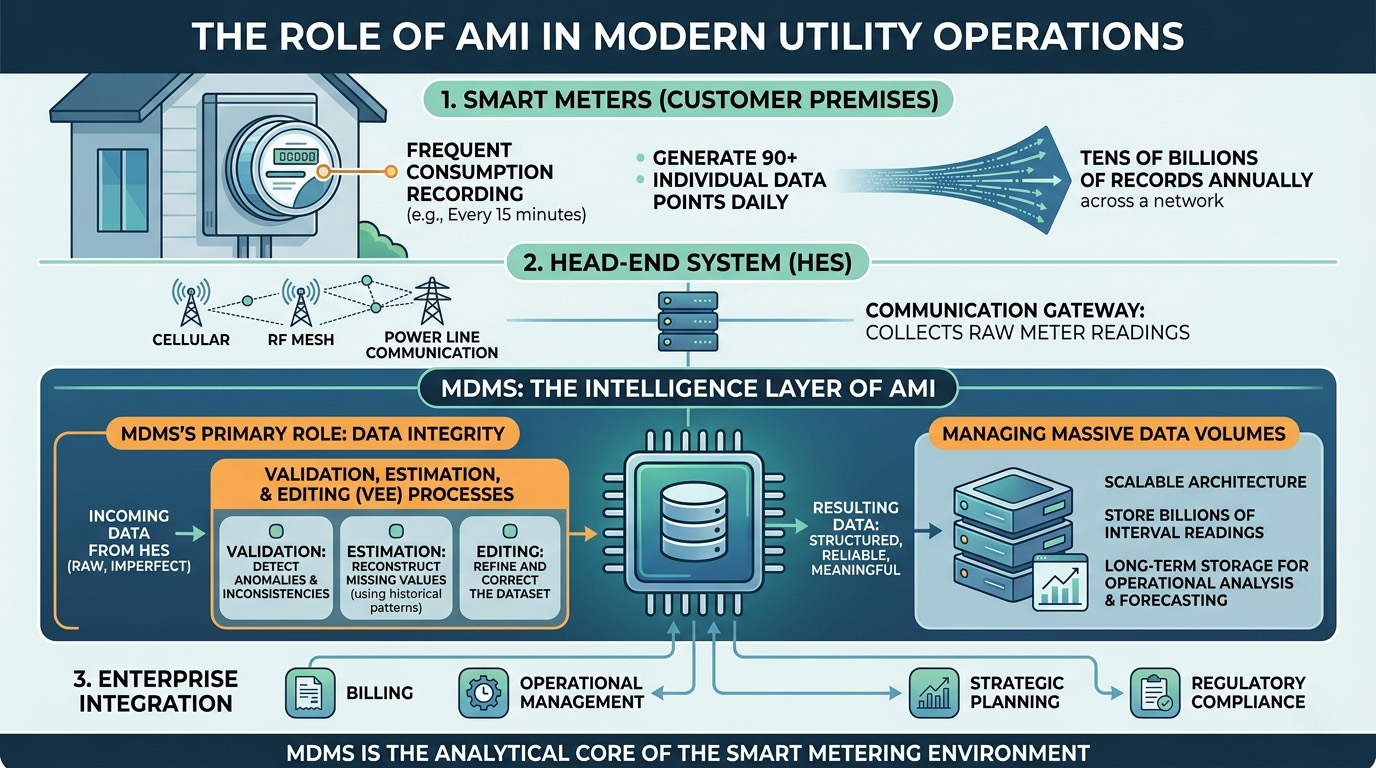
Smart meters represent the first step in this process. Unlike traditional mechanical meters that are read manually once per billing cycle, smart meters record consumption at frequent intervals. Many utilities configure meters to capture readings every fifteen minutes, which means that a single device can generate
more than ninety individual data points per day. Over the course of a year, that same meter may produce tens of thousands of consumption records. When multiplied across a network of hundreds of thousands or even millions of meters, the scale of data generated by AMI becomes extraordinary. A utility operating one million smart meters can easily accumulate tens of billions of data records annually. Managing and interpreting such a massive stream of information requires specialized data management systems designed specifically for the utility environment.
Between the smart meters and the utility’s data platforms lies another important component known as the Head-End System (HES). This system functions as the communication gateway that collects readings from field devices through technologies such as cellular networks, RF mesh communication, or power line communication. The Head-End System gathers the raw meter data and forwards it to the utility’s data infrastructure. However, while HES enables communication and data collection, it does not perform the complex data validation, processing, and analysis required for operational use.
This is where the Meter Data Management System becomes indispensable.
MDMS: The Intelligence Layer of AMI
The Meter Data Management System (MDMS) sits at the center of the AMI architecture, acting as the analytical and operational core of the smart metering environment. Its primary role is to transform raw meter readings into structured, reliable, and meaningful information that utilities can use for billing, operational management, and strategic planning. When data arrives from the Head-End System, it is rarely perfect. Communication disruptions, device malfunctions, and temporary network failures can result in missing or inconsistent readings. If these issues are not addressed before the data reaches downstream systems, the consequences can be significant. Billing inaccuracies may occur, analytics may produce misleading results, and operational decisions may be based on incomplete information.
To resolve these challenges, MDMS applies sophisticated processes known in the industry as Validation, Estimation, and Editing (VEE). These processes ensure that meter readings are accurate, consistent, and complete before they are used by other systems within the utility enterprise. Validation procedures check incoming data against predefined rules to detect anomalies or inconsistencies. When readings are missing due to communication interruptions or device issues, estimation algorithms reconstruct the most probable values based on historical consumption patterns. Editing functions then refine and correct the dataset to ensure that it accurately represents actual consumption. Through these mechanisms, MDMS protects the integrity of the utility’s data ecosystem. Reliable data is essential not only for accurate billing but also for regulatory compliance, operational analysis, and long- term planning.
Managing Massive Volumes of Meter Data
One of the defining characteristics of AMI deployments is the enormous volume of data they produce. Traditional utility databases were never designed to handle billions of interval readings. MDMS platforms are specifically engineered to address this challenge, providing scalable architectures capable of storing, organizing, and processing large datasets efficiently.
Because utilities must maintain historical records for operational analysis and regulatory requirements, MDMS systems often manage years of interval consumption data. This long-term storage capability enables utilities to track consumption patterns over time, evaluate infrastructure performance, and support advanced forecasting models.
The ability to manage such extensive datasets is not merely a technical convenience—it is a necessity. Without a robust data management platform, the data generated by smart meters would quickly overwhelm conventional systems, preventing utilities from extracting meaningful insights.
Detecting Anomalies and Protecting Revenue
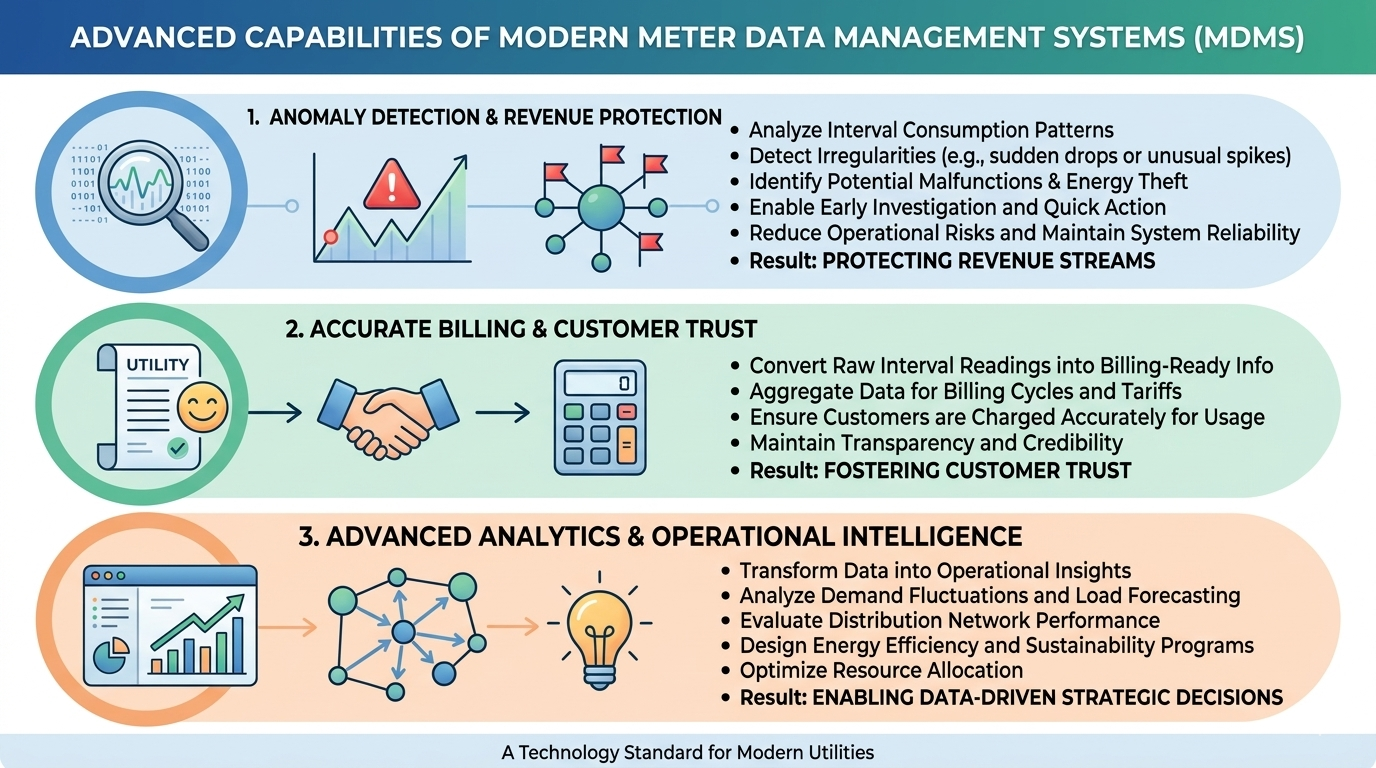
Beyond its role in data management and validation, MDMS also plays an important role in operational monitoring. By analyzing interval consumption patterns, the system can detect irregularities that may indicate potential problems within the network. For example, sudden drops in consumption may suggest meter malfunction or communication failure. Unusual spikes in usage could indicate equipment faults or unauthorized consumption. In some cases, these anomalies may signal deliberate tampering or energy theft.
By identifying these irregular patterns early, MDMS enables utilities to investigate issues quickly and take corrective action. This capability is particularly valuable in large-scale deployments where manual monitoring would be impossible. The ability to detect anomalies automatically helps utilities reduce operational risks, maintain system reliability, and protect revenue streams.
Enabling Accurate Billing and Customer Trust
Accurate billing remains one of the most visible outcomes of effective meter data management. Billing systems depend on precise consumption data in order to calculate customer charges correctly. Raw interval readings collected from smart meters cannot simply be transferred directly into billing platforms
without proper processing.
MDMS performs the essential task of converting raw meter data into billing-ready information. After validation and processing, interval readings are aggregated into structured consumption values that correspond to billing cycles and tariff structures. This transformation ensures that customers are charged accurately for the services they consume.
The reliability of this process directly affects customer trust. Billing errors can lead to disputes, administrative costs, and reputational damage. By ensuring that billing data is accurate and consistent, MDMS plays a critical role in maintaining transparency and credibility in the relationship between utilities and their customers.
Supporting Advanced Analytics and Operational Intelligence
As utilities embrace data-driven decision making, the information managed by MDMS becomes a powerful resource for operational insight. Beyond billing and data validation, MDMS enables utilities to analyze consumption patterns, monitor demand fluctuations, and evaluate the performance of distribution networks.
These analytical capabilities allow utilities to better understand how energy or water flows through their infrastructure. By identifying patterns and trends within consumption data, utilities can anticipate peak demand, improve load forecasting, and optimize resource allocation.
MDMS also supports programs focused on energy efficiency and demand management. By analyzing consumption data across different customer segments, utilities can design targeted initiatives that encourage more efficient energy use. Such programs not only improve system performance but also support broader sustainability goals.

MDMS as the Data Hub of the Utility Enterprise
Modern utilities rely on a wide range of enterprise systems to manage operations. These systems include Customer Information Systems (CIS), outage management platforms, enterprise resource planning systems, distribution management tools, and advanced analytics platforms. Each of these systems depends
on accurate and consistent consumption data.
MDMS acts as the central hub that supplies this information. By consolidating validated meter data in one location, the system ensures that all downstream platforms operate using the same reliable dataset. This unified data architecture enables seamless integration between operational systems, allowing utilities to
coordinate activities more effectively and respond to network events with greater speed and precision. Without this central data management layer, different systems might rely on inconsistent or incomplete information, leading to operational inefficiencies and conflicting insights.
The Risks of Operating Without a Robust MDMS
The importance of MDMS becomes even clearer when considering the challenges utilities face without it.
Raw data collected from smart meters cannot be relied upon without validation and processing. If utilities attempt to operate without a robust meter data management platform, several issues may arise.
Billing inaccuracies may become more frequent as incomplete or inconsistent readings flow into billing systems. Data gaps may remain unresolved, weakening the reliability of operational reports and analytics.
Analytical models built on poor-quality data may produce misleading conclusions, affecting infrastructure planning and investment decisions. At the same time, the risk of revenue leakage may increase due to undetected anomalies or tampering.
In essence, the absence of a strong data management system undermines the entire value proposition of smart metering infrastructure.
From Raw Data to Business Intelligence
The journey from a meter reading to meaningful operational insight involves several stages. Smart meters generate detailed consumption data at regular intervals. Communication systems collect this data and transmit it to the utility environment. MDMS then processes the information, ensuring that it is accurate, complete, and structured for operational use.
Through this process, raw data is transformed into business intelligence. The information becomes usable by billing systems, operational platforms, and analytical tools across the utility enterprise. This transformation represents the true value of AMI deployments. Without the ability to convert raw data into actionable knowledge, the benefits of smart metering would remain largely unrealized.
The Future Role of MDMS in Digital Utilities
As the global utility sector continues to evolve, the role of MDMS will become even more critical. The integration of renewable energy resources, distributed generation technologies, electric vehicles, and intelligent grid infrastructure is increasing the complexity of utility operations. These developments will generate even greater volumes of data that must be processed and interpreted in real time.
Future MDMS platforms are expected to incorporate advanced capabilities such as machine learning, predictive analytics, and real-time data processing. These innovations will allow utilities to detect emerging issues before they escalate, optimize network performance dynamically, and support increasingly sophisticated grid management strategies.
In this rapidly evolving landscape, the ability to manage and interpret data effectively will determine the success of digital utility initiatives.
Conclusion
Advanced Metering Infrastructure represents one of the most significant technological transformations in the history of utility operations. By enabling continuous measurement and communication of consumption data, AMI provides utilities with unprecedented visibility into their networks. However, the value of this infrastructure depends entirely on the ability to transform raw meter readings into reliable and actionable insights.
The Meter Data Management System (MDMS) performs this essential function. By validating, processing, storing, and distributing meter data across the utility enterprise, MDMS ensures that information is accurate, consistent, and ready for operational use. It supports billing accuracy, enables advanced analytics, detects anomalies, and connects multiple enterprise systems through a unified data platform.
For these reasons, MDMS is widely recognized as the heart of Advanced Metering Infrastructure. As utilities continue their journey toward fully digital, intelligent networks, the role of MDMS will remain central to unlocking the full potential of smart metering and building resilient, data-driven utility systems for the future.