

Advanced Metering Infrastructure (AMI) Software Platform
A Scalable Digital Foundation for Modern Utility Management
Introduction
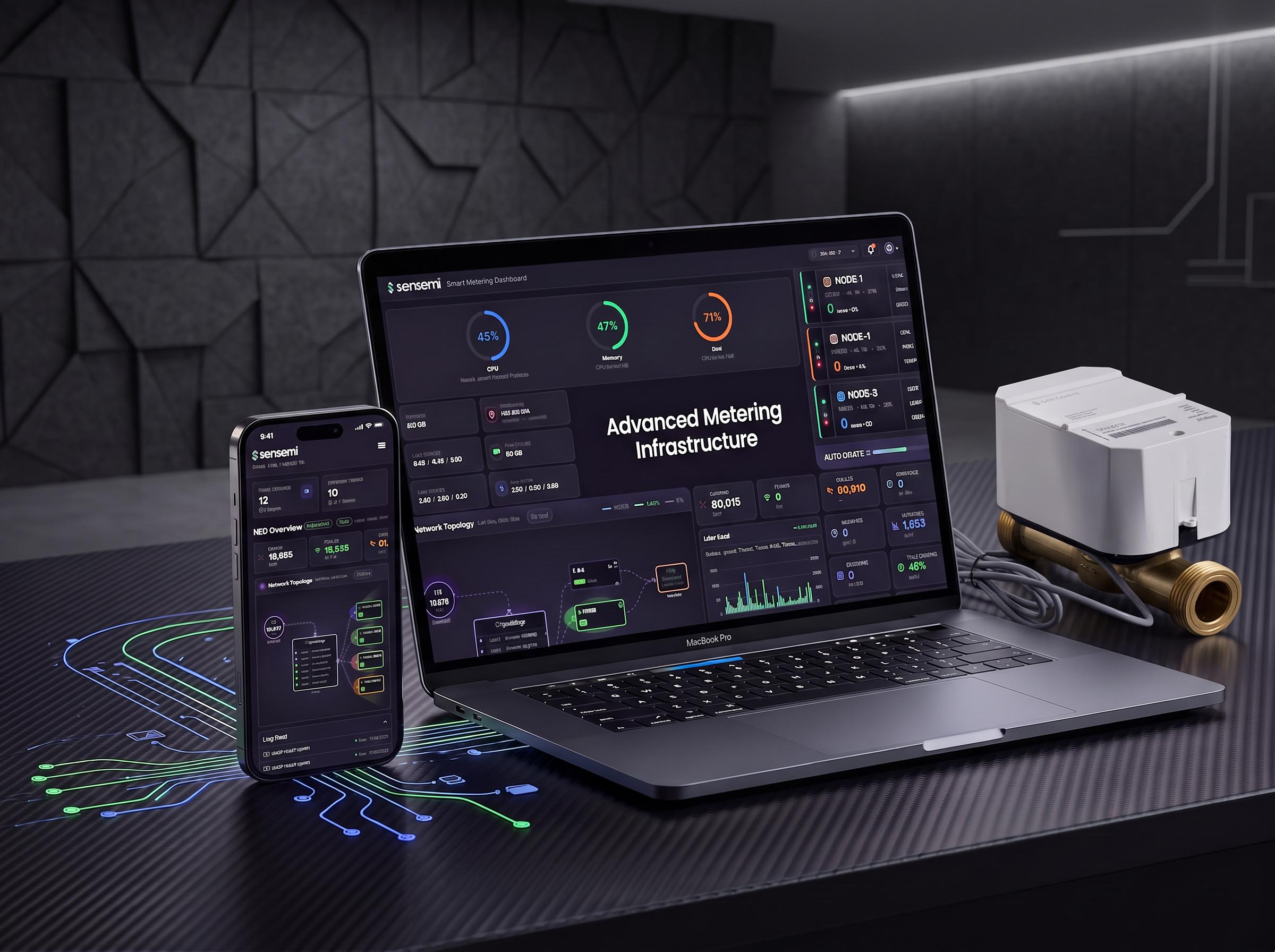
Advanced Metering Infrastructure (AMI) is a web-based system that enables remote monitoring, management, and control of smart meters and associated devices. The system provides real-time access to meter readings, event monitoring, billing, and operational analytics, allowing utilities to improve efficiency, reduce manual interventions, and enhance service reliability.
The system is designed for utility operators and administrators, providing a complete view of the electrical network, meter status, and operational data in real time. Users can customize views, filter data, and perform both single meter and batch operations to maintain efficient network management.
The global utility sector is undergoing a profound digital transformation. As energy networks become more complex and cities evolve toward smarter infrastructure, traditional metering systems are no longer sufficient to meet the operational demands of modern utilities. The need for accurate, real-time data, secure communication, and large-scale device management has driven the adoption of Advanced Metering Infrastructure (AMI) platforms.
AMI is more than simply replacing conventional meters with smart devices. It represents a comprehensive digital ecosystem that connects smart meters, communication networks, data management platforms, and enterprise systems into a unified operational framework. Through this integrated architecture, utilities can collect, analyze, and act upon vast volumes of consumption data while maintaining operational efficiency and reliability.
SenseMi’s AMI software platform has been designed to support this transformation. By combining advanced communication technologies, scalable data management systems, and intelligent monitoring tools, the platform enables utilities to manage large-scale metering deployments with precision, security, and flexibility.
Beyond traditional automated meter reading, modern AMI systems play a strategic role in enabling digital utility operations. As utilities integrate renewable energy, distributed energy resources, and new smart grid technologies, AMI platforms provide the visibility and operational intelligence required to manage increasingly dynamic networks.
The Architecture of the SenseMi AMI Platform
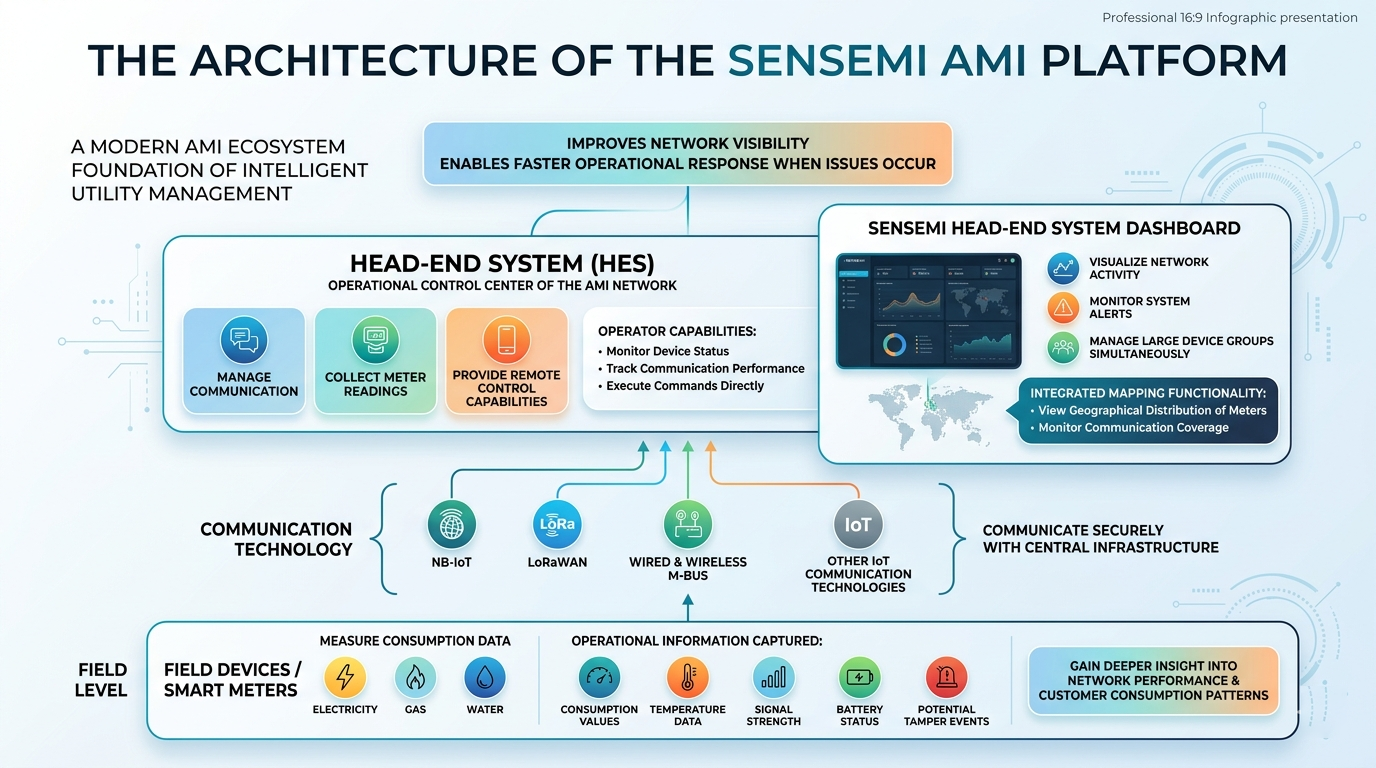
A modern AMI ecosystem is built on multiple interconnected layers that together form the foundation of intelligent utility management. SenseMi’s platform integrates these layers into a cohesive architecture that connects field devices with enterprise systems.
At the field level, smart meters continuously measure consumption data for electricity, gas, water, or other utilities. These devices capture a wide range of operational information including consumption values, temperature data, signal strength, battery status, and potential tamper events. The ability to capture detailed operational data allows utilities to gain deeper insight into network performance and customer consumption patterns.
These meters communicate securely with the central infrastructure through a variety of communication technologies. SenseMi’s architecture supports multiple communication methods including NB-IoT, LoRaWAN, wired and wireless M-Bus, and other IoT communication technologies, allowing utilities to select the most appropriate connectivity option for their operational environment.
Above the field device layer, the Head-End System (HES) functions as the operational control center of the AMI network. The HES manages communication between meters and the central platform, collects meter readings, and provides remote control capabilities for devices deployed in the field. Operators can monitor device status, track communication performance, and execute commands directly through the centralized interface.
The SenseMi Head-End System provides a powerful dashboard environment where operators can visualize network activity, monitor system alerts, and manage large groups of devices simultaneously. Through integrated mapping functionality, utilities can view the geographical distribution of installed meters and monitor communication coverage across their service territory. This spatial awareness improves network visibility and enables faster operational response when issues occur.
Meter Data Management and Intelligent Data Processing
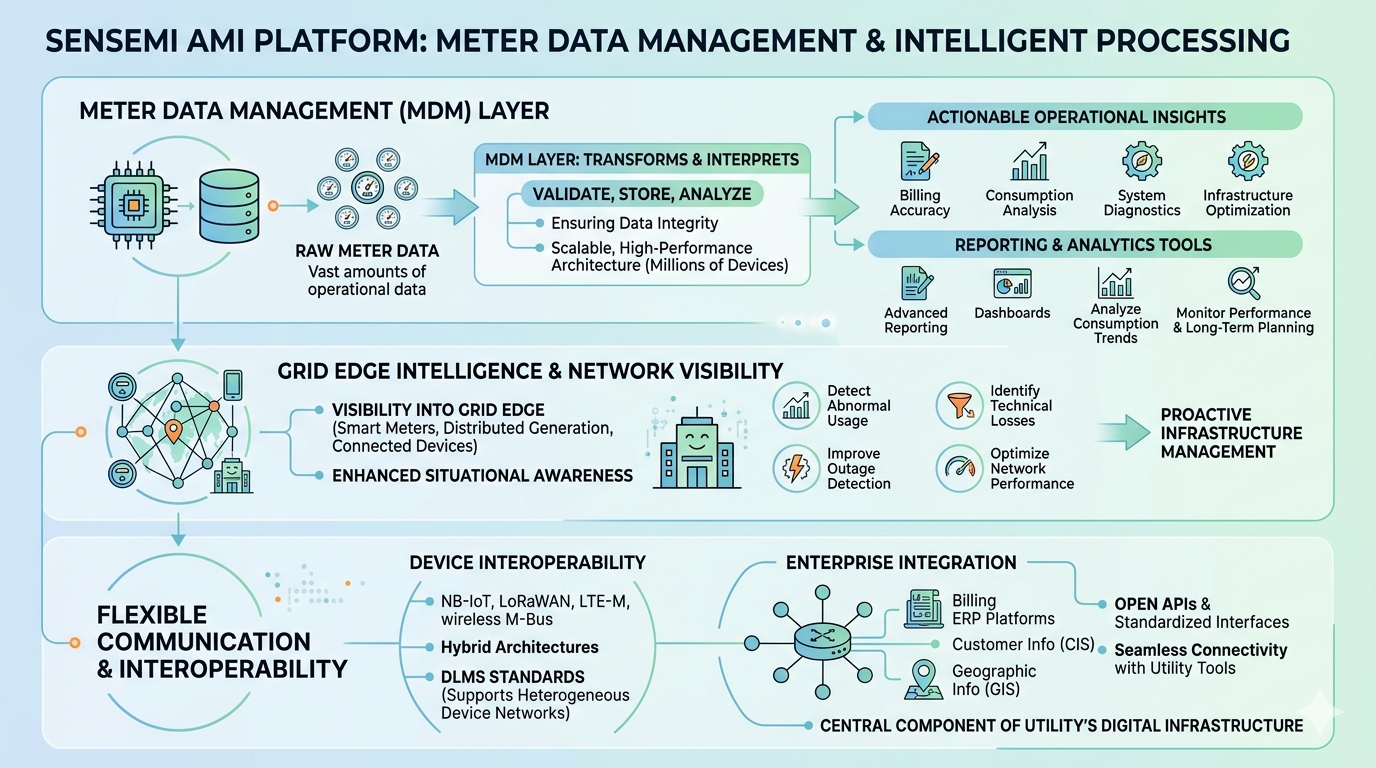
While smart meters generate vast amounts of operational data, the true value of AMI lies in the ability to process and interpret that information effectively. This responsibility is handled by the Meter Data Management (MDM) layer, which transforms raw meter readings into structured and reliable data that can support operational decision-making.
The SenseMi AMI platform includes a robust data management system designed to collect, validate, store, and analyze large volumes of metering data. The system processes interval consumption readings, instantaneous meter values, event logs, and operational alerts while ensuring data integrity through validation and pre-processing mechanisms.
Through advanced analytics and reporting capabilities, utilities can transform raw meter data into actionable operational insights. These insights support a wide range of applications including billing accuracy, consumption analysis, system diagnostics, and infrastructure optimization. By identifying irregular consumption patterns or network anomalies, utilities can proactively address issues before they escalate into larger operational problems.
The platform is engineered to handle high-volume data environments where millions of devices may transmit readings multiple times per day. Through scalable architecture and high-performance processing capabilities, the system can efficiently manage the continuous flow of data generated by large-scale smart metering deployments.
In addition to data collection and validation, the platform supports advanced reporting, dashboards, and analytics tools that enable utilities to analyze consumption trends, monitor infrastructure performance, and support long-term planning initiatives.
Grid Edge Intelligence and Network Visibility
As energy systems become more distributed and dynamic, utilities require deeper visibility into the outer layers of the network, often referred to as the grid edge.
The grid edge includes smart meters, distributed generation assets, and connected devices installed throughout the distribution network. These devices generate large volumes of operational data that provide valuable insight into consumption behavior and infrastructure performance.
By integrating this data into the AMI platform, utilities gain enhanced situational awareness and operational intelligence. Grid edge intelligence enables utilities to detect abnormal usage patterns, identify technical losses, improve outage detection, and optimize network performance.
Rather than reacting to operational issues after they occur, utilities can use data-driven insights to proactively manage infrastructure and improve overall service reliability.
Flexible Communication and Interoperability
Utility networks often operate in diverse environments where communication reliability is critical. The SenseMi AMI solution addresses this challenge by supporting a flexible communication architecture capable of integrating multiple technologies and protocols.
The platform supports communication standards such as DLMS, ensuring interoperability with a wide range of industry-standard metering devices. This allows utilities to deploy heterogeneous device networks while maintaining consistent data management and system control.
SenseMi’s AMI platform also supports hybrid communication architectures that combine multiple connectivity technologies such as NB-IoT, LoRaWAN, LTE-M, and wireless M-Bus. This flexibility allows utilities to maintain reliable connectivity even in challenging network environments.
The AMI software also supports integration with external enterprise systems through open APIs and standardized interfaces. This enables seamless connectivity with billing systems, ERP platforms, customer information systems, geographic information systems (GIS), and other utility management tools.
By enabling data exchange across multiple systems, the AMI platform becomes a central component of the utility’s digital infrastructure.
Remote Device Management and Network Control
One of the most significant operational advantages of AMI technology is the ability to manage devices remotely. Traditional metering infrastructures often require field technicians to perform manual operations such as meter reading, device configuration, or maintenance procedures.
AMI platforms eliminate much of this operational overhead by enabling centralized remote control of field devices.
Through the SenseMi Head-End interface, operators can configure device parameters, adjust communication intervals, and execute commands directly from the control center. The system supports a wide range of remote operations including meter configuration, command execution, firmware upgrades, and valve control.
Firmware updates can be deployed over-the-air, allowing utilities to update device software across thousands of meters without requiring physical access to the devices. This capability
significantly reduces operational costs while ensuring that the metering infrastructure remains up-to-date with the latest features and security improvements.
The platform also allows utilities to monitor battery levels, signal strength, and device health indicators in real time. By continuously tracking device status, operators can detect potential issues early and schedule maintenance activities more efficiently.
Security and Data Integrity
As critical infrastructure becomes increasingly connected, ensuring the security of metering networks is essential. The SenseMi AMI platform incorporates multiple layers of security designed to protect both operational systems and sensitive data.
Secure communication protocols, encryption mechanisms, and authentication frameworks are implemented to ensure that only authorized devices and users can access the system. Centralized management of security keys and certificates further enhances protection against unauthorized access.
The system also incorporates advanced monitoring capabilities that detect potential tampering events and abnormal usage patterns. By identifying irregular activity within the network, utilities can respond quickly to potential threats and maintain the integrity of their metering infrastructure.
Operational Advantages for Utilities
Deploying an advanced AMI software platform provides utilities with numerous operational and financial benefits.
Automated meter reading eliminates the need for manual data collection, significantly reducing operational costs and improving billing accuracy. Real-time access to consumption data allows utilities to analyze usage patterns, detect network inefficiencies, and optimize resource distribution.
Detailed consumption insights also enable utilities to implement demand response programs and support energy efficiency initiatives. Continuous monitoring of infrastructure performance improves system reliability while reducing service interruptions. Advanced data analytics also help utilities detect technical losses, identify tampering events, and enhance overall network efficiency.
Through these capabilities, AMI systems evolve from simple metering tools into strategic digital platforms that support the long-term modernization of utility infrastructure.
Supporting the Future of Smart Utility Networks
As the energy landscape evolves, utilities must adapt to new operational challenges including distributed energy resources, increased electrification, and the integration of smart grid technologies. Intelligent metering platforms will play a central role in enabling this transition. SenseMi’s AMI software platform has been designed with scalability and adaptability in mind.
Its modular architecture allows utilities to expand their metering infrastructure, integrate additional communication technologies, and connect new enterprise systems as operational needs grow.
By combining secure communication, scalable data management, and advanced device control capabilities, the SenseMi AMI platform provides utilities with a powerful digital foundation for the next generation of smart infrastructure.
Through its integrated architecture and advanced software capabilities, SenseMi’s AMI solution enables utilities to move beyond traditional metering toward data-driven, intelligent utility management, supporting more efficient, reliable, and sustainable energy networks.