

SenseMi Smart Metering Head-End System
The SenseMi Smart Metering Head-End System (HES) is a scalable platform that centrally manages electricity, gas, and water smart meters using hybrid communication technologies (NB-IoT, LoRaWAN, M-Bus) to enable secure connectivity, monitoring, and efficient utility operations.

Advanced Platform for Intelligent Utility Meter Management
The SenseMi Smart Metering Head-End System (HES) is a powerful and scalable platform designed to manage modern smart metering infrastructure across electricity, gas, and water networks. Integrated with the SYNC200 Hybrid Communication Module, the system enables utilities to monitor, control, and optimize large-scale meter deployments through a centralized and intelligent management interface.
With support for advanced communication technologies such as NB-IoT, LoRaWAN, and M- Bus, the SenseMi platform ensures reliable connectivity and secure data transmission across diverse network environments.
By combining advanced software architecture, hybrid communication capabilities, and powerful analytics, the SenseMi Head-End System enables utilities to improve operational efficiency, enhance visibility across their metering networks, and accelerate digital transformation.
Real-Time Monitoring with an Intelligent Dashboard
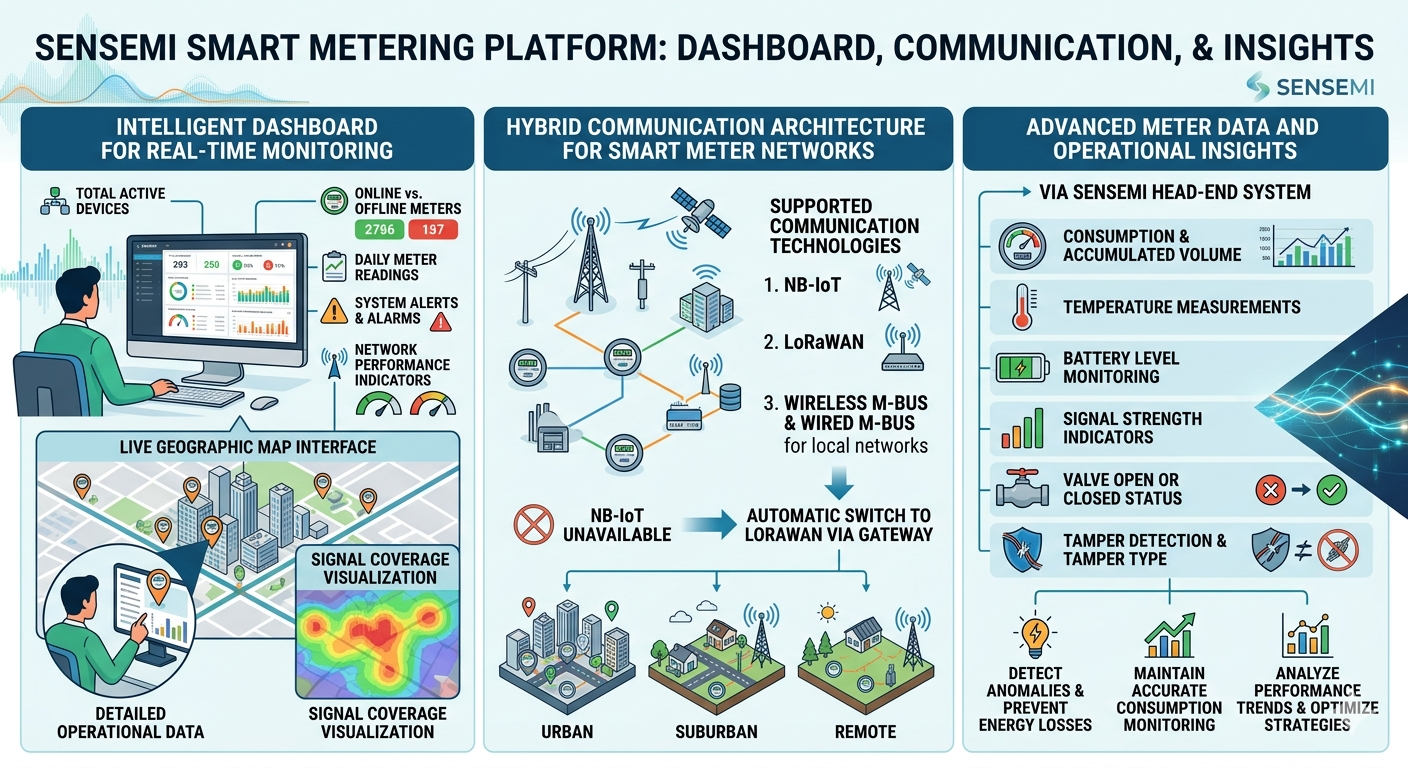
The SenseMi platform features a powerful and intuitive dashboard designed to provide operators with a complete overview of the metering infrastructure.
Through the dashboard interface, utilities can monitor:
Total number of active devices
Online and offline meters
Daily meter readings
System alerts and alarms
Network performance indicators
A live geographic map interface allows operators to visualize meter locations and network performance in real time. Each device can be selected directly on the map to access detailed operational data, enabling faster diagnostics and improved operational visibility.
The system also provides signal coverage visualization, allowing operators to analyze network connectivity and identify potential communication gaps.
Hybrid Communication Architecture for Smart Meter Networks
The SenseMi Smart Metering platform is designed with a hybrid communication architecture, enabling reliable connectivity through multiple technologies.
Supported communication technologies include:
1. NB-IoT for wide-area cellular connectivity
2. LoRaWAN for long-range, low-power communication
3. Wireless M-Bus and Wired M-Bus for local communication networks
This hybrid communication capability ensures continuous connectivity even in complex deployment environments. If NB-IoT communication is unavailable or unstable, devices can automatically switch to LoRaWAN communication via gateway infrastructure.
This flexible architecture allows utilities to deploy smart meters across urban, suburban, and remote areas with reliable communication performance.
Advanced Meter Data and Operational Insights
The SenseMi Head-End System provides utilities with deep visibility into meter performance and consumption data.
Key operational parameters monitored by the system include:
Consumption and accumulated volume readings
Temperature measurements
Battery level monitoring
Signal strength indicators
Valve open or closed status
Tamper detection and tamper type identification
These insights allow operators to detect anomalies, prevent energy losses, and maintain accurate monitoring of utility consumption.
The platform also enables utilities to analyze performance trends and optimize operational strategies based on real-time and historical data.
Remote Meter Configuration and Control
The SenseMi system enables remote configuration and management of smart meters directly through the Head-End dashboard.
Operators can perform the following actions remotely:
✓ Configure meter transmission intervals (from minutes to daily reporting)
✓ Adjust communication parameters
✓ Execute remote commands
✓ Control valve opening and closing
✓ Reset pulse counters
✓ Clear tamper alerts
✓ Set meter offset values during device replacement
Remote device control reduces field operations, minimizes maintenance costs, and significantly improves operational efficiency for utility providers.
Secure IoT Communication Protocols
To ensure secure and efficient communication between meters and servers, the SenseMi platform supports industry-standard IoT communication protocols.
LwM2M Protocol
The system uses LwM2M (Lightweight Machine-to-Machine) protocol for efficient IoT communication.
Benefits include:
✓ Secure device communication
✓ Reduced data usage
✓ Lower power consumption
✓ Efficient transmission of detailed device information
DLMS Protocol
The system also supports DLMS protocol, enabling compatibility with traditional smart meter communication systems and allowing field technicians to retrieve meter data through optical readers.
M-Bus Integration
Both wired and wireless M-Bus communication can be configured for integration with existing metering infrastructure.
Over-the-Air Firmware Updates (OTA)
SenseMi’s Head-End System supports remote firmware upgrades, allowing utilities to maintain
and improve device performance without physical intervention.
Through OTA updates:
✓ New firmware files can be uploaded to the server
✓ Meters automatically receive update notifications
✓ Firmware upgrades are downloaded during the next communication cycle
✓ Devices install updates securely
The platform also supports bulk firmware updates, allowing utilities to upgrade large groups of
meters simultaneously.
Over-the-Air Firmware Updates (OTA)
SenseMi’s Head-End System supports remote firmware upgrades, allowing utilities to maintain and improve device performance without physical intervention.
Through OTA updates:
✓ New firmware files can be uploaded to the server
✓ Meters automatically receive update notifications
✓ Firmware upgrades are downloaded during the next communication cycle
✓ Devices install updates securely
The platform also supports bulk firmware updates, allowing utilities to upgrade large groups of meters simultaneously.
Historical Data and Performance Analytics
The platform maintains comprehensive historical records for each device, allowing utilities to analyze performance trends and system behavior over time.
Historical insights include:
❖ Consumption history
❖ Battery performance trends
❖ Signal strength variations
❖ Alert and tamper event history
This data enables predictive maintenance and long-term system optimization.
Metering Point Management and ERP Integration
SenseMi’s metering management system allows utilities to link smart meters with real-world installation data.
Meters can be associated with:
➢ Buildings
➢ Apartments
➢ Installation locations
➢ Customer accounts
Through the system’s API integration, these data points can be synchronized with enterprise systems such as ERP platforms, billing systems, or utility management software. This ensures seamless integration between operational systems and administrative infrastructure.
Intelligent Alert and Event Management
The platform supports customizable alert rules that allow utilities to monitor specific operational parameters.
Alert rules can be configured based on:
▪ Signal strength thresholds
▪ Battery level alerts
▪ Communication failures
▪ Tamper detection events
For example, the system can automatically trigger a warning if signal strength falls below a predefined threshold.
This automated alert system allows operators to respond quickly to operational issues and maintain network reliability.
Role-Based Access Control for Large Utility Networks
SenseMi provides a flexible role-based user management system that enables administrators to control user permissions across the platform.
Operators can be assigned access to specific:
→ Devices
→ Buildings
→ Geographic regions
→ Meter groups
This improves operational security while allowing teams to efficiently manage large-scale smart metering deployments.
Enabling the Future of Digital Utility Infrastructure
The SenseMi Smart Metering Head-End System and SYNC200 Hybrid Communication Module provide utilities with a powerful digital platform for managing modern smart metering ecosystems.
By integrating hybrid connectivity, secure communication protocols, advanced analytics, and remote device management, SenseMi empowers utilities to:
Improve operational efficiency
Reduce maintenance costs
Enhance infrastructure visibility
Accelerate digital transformation
The platform is designed to support the evolving needs of global utilities and the transition toward smarter, more connected infrastructure.