

Why M-Bus Remains a Cornerstone in Modern Smart Metering
Choosing the right communication protocol is a critical strategic decision in modern smart grid metering, as digital transformation demands solutions that deliver accuracy, reliability, scalability, and low total cost of ownership.

As utility networks evolve rapidly toward digital transformation, choosing the right communication protocol remains one of the most strategic decisions for any metering deployment. Today’s smart grids demand accuracy, reliability, scalability, and low cost of ownership, criteria where many general-purpose solutions struggle to deliver consistently. Amidst a crowded landscape of communication technologies, M-Bus (Meter-Bus) stands out as an enduring and effective foundation for large-scale metering systems. At SenseMi, we integrate M-Bus with advanced utility intelligence to empower utilities with dependable data collection and long-term operational stability.

Understanding M-Bus:
Designed for Metering, Not Repurposed for It
M-Bus was purpose-built to serve metering applications, and this core focus differentiates it from many other communication standards. While IP-based or wireless technologies such as cellular and LPWAN target general connectivity applications, M-Bus was engineered from the ground up for meter reading, with a deep understanding of field constraints, device energy profiles, and the requirements of billing-grade data.
Key principles behind M-Bus design include:
Simplicity: Minimal configuration and straightforward network topology
Interoperability: Open standards ensure multi-vendor compatibility
Efficiency: Optimized for consistent meter data delivery This design philosophy has made M-Bus a reliable workhorse in utility communications for decades.
Wired M-Bus:
Stability and Predictability in Critical Environments
In installations where data integrity and communication stability are paramount, Wired M-Bus continues to be a preferred choice. This technology leverages a robust physical medium and deterministic behavior that is well-suited for environments where wireless signals may falter.
Technical Characteristics of Wired M-Bus
Wired M-Bus communication typically includes:
1. A two-wire physical connection that serves as both data and power path
2. Support for hundreds of endpoint meters on a single bus
3. Low electrical noise sensitivity, making it ideal for industrial or congested environments
These characteristics make Wired M-Bus particularly relevant for applications such as:
→ District heating and cooling networks
→ Multi-tenant residential or commercial buildings
→ Industrial utility distribution systems
Unlike many wireless solutions that depend on variable signal environments, Wired M-Bus delivers predictable and interference-resilient communication across long cable distances.
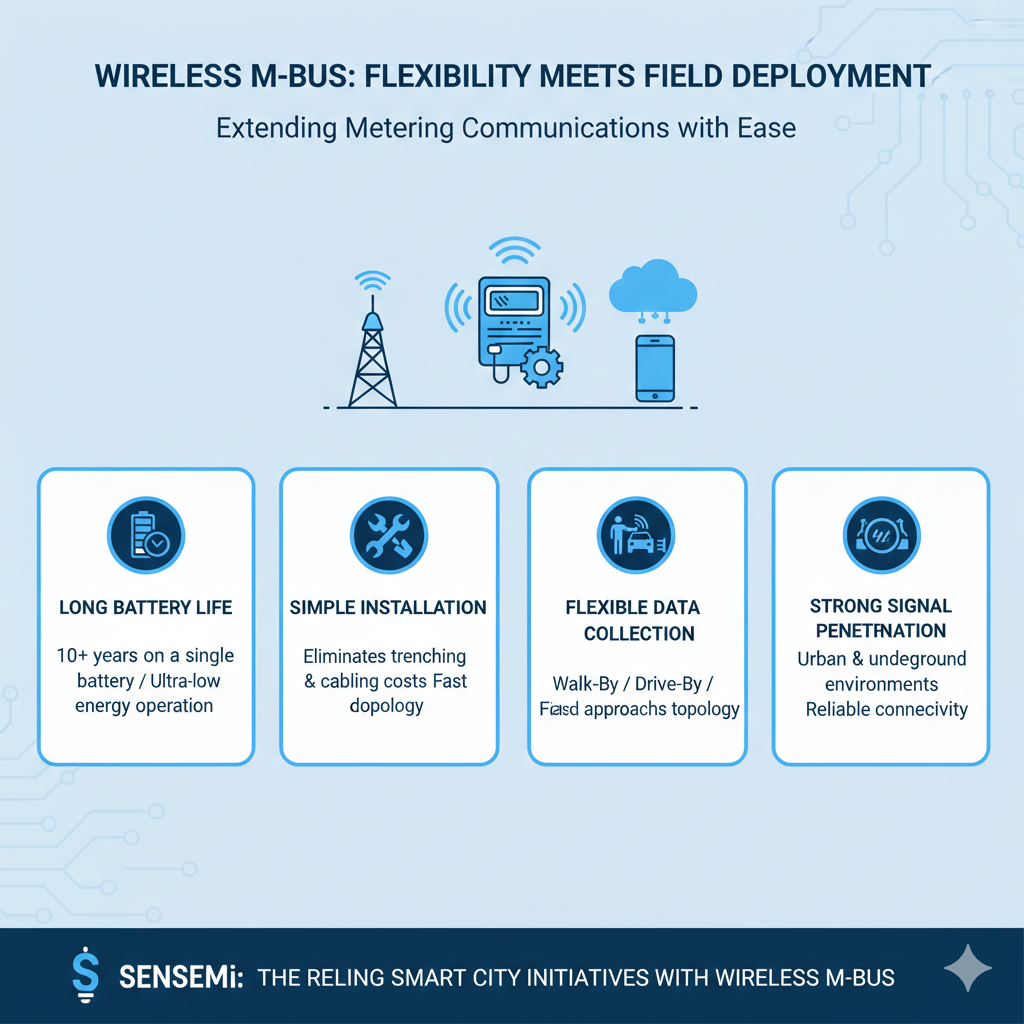
Wireless M-Bus:
Flexibility Meets Field Deployment
As utility networks expand and retrofitting becomes more common, Wireless M-Bus has emerged as a powerful complement to its wired counterpart. With support for sub-GHz ISM
bands and ultra-low energy operation, Wireless M-Bus extends M-Bus communication into scenarios where cable infrastructure is unfeasible or costly.
Why Wireless M-Bus Matters
Long Battery Life: Many meters operate for 10+ years on a single battery
Simple Installation: Eliminates trenching and cabling costs
Walk-By / Drive-By / Fixed Gateways: Offers multiple data collection approaches
Strong Signal Penetration: Performs well in urban and underground environments
Wireless M-Bus is widely deployed across Europe and beyond, especially in smart city initiatives where existing infrastructure must be leveraged efficiently.
Main Advantages of M-Bus Across Smart Metering Projects
1. Built for Reliability
M-Bus delivers consistent communication even in environments with high electrical noise or structural interference. Unlike many IP-centric protocols that require network optimization and
tuning, M-Bus operates with minimal overhead and predictable timing, critical for billing and compliance.
2. Low Power Consumption
For water, gas, and heat metering devices that aren’t always connected to mains power, energy efficiency is essential. M-Bus endpoints are optimized to consume minimal power, enabling
long operational life ,often more than a decade, without frequent maintenance or battery replacement.
Comparing M-Bus With Other Communication Technologies

M-Bus may not always be the lowest cost route for every use case, but where data accuracy, long lifecycle, and network predictability matter most, it remains one of the most effective choices.
Standards, Interoperability, and Ecosystem Integration
One of the key strengths of M-Bus is its adherence to open communication standards. This ensures that meters, data concentrators, and head-end systems from different manufacturers can
interoperate seamlessly without vendor lock-in.
At SenseMi, our M-Bus solutions are designed to integrate into:
• Advanced Metering Infrastructure (AMI) platforms
• Utility analytics dashboards
• Enterprise resource planning (ERP) systems
• IoT and edge management frameworks
This ecosystem support enables utilities to leverage M-Bus data for broader operational intelligence, network optimization, and customer engagement.
Future-Proofing Smart Metering with M-Bus
In an industry driven by digital transformation, the value of backward compatibility and long-term support cannot be overstated. M-Bus provides a migration path that allows utilities to:
→ Begin with basic consumption measurement
→ Add advanced communication modules later
→ Integrate with wide-area connectivity solutions as needed
This flexible evolution strategy protects infrastructure investments and supports phased modernization strategies without disruptive overhaul.
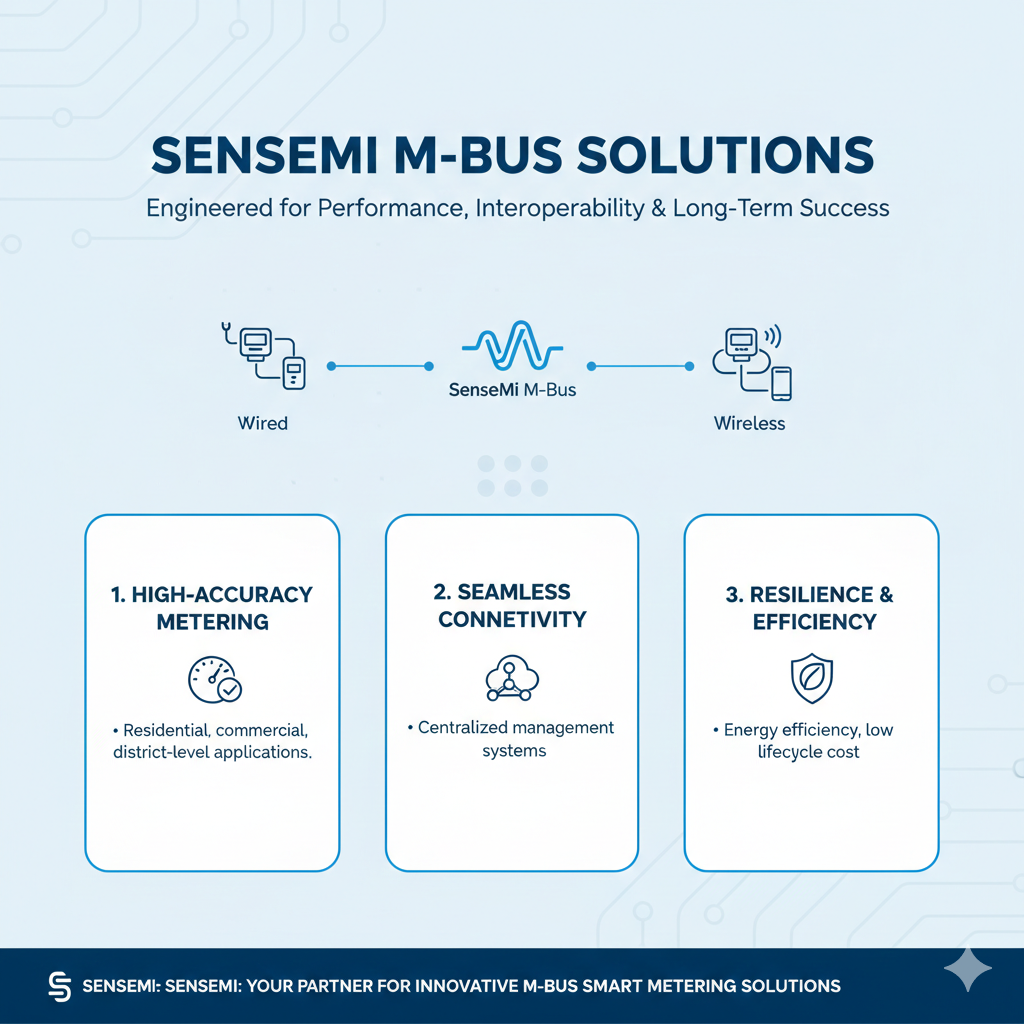
SenseMi M-Bus Solutions
SenseMi’s engineered M-Bus products bring the benefits of a proven standard into modern smart metering systems. Our portfolio supports both Wired and Wireless M-Bus, providing:
✓ High-accuracy metering for residential, commercial, and district-level applications
✓ Seamless connectivity with centralized management systems
✓ Resilience, energy efficiency, and low lifecycle cost
By choosing SenseMi, utilities gain a partner committed to performance, interoperability, and long-term operational success.
Conclusion
While new communication technologies grow in popularity, M-Bus remains a foundational technology in smart metering due to its reliability, simplicity, and scalability. Whether deployed in wired form for maximum stability or wirelessly for flexible field operations, M-Bus continues to deliver measurable value to utilities worldwide.
If your utility’s priority is accuracy, long-term reliability, and operational efficiency, M-Bus should be a central part of your smart metering strategy.
Contact SenseMi
Transform your utility infrastructure with robust M-Bus metering solutions. Contact SenseMi to explore the best configuration, deployment plan, and long-term roadmap tailored to your network.