

Smart Water Metering as the Foundation of Resilient and Data Driven Water Utilities
How Accurate Measurement, Advanced Metering Infrastructure, and Real-Time Data Are Transforming Modern Water Management
Introduction
Water utilities are entering a period in which the reliability of physical infrastructure can no longer be separated from the quality of the data used to operate it. Population growth, urban expansion, water scarcity, aging distribution networks, rising energy costs, stricter regulatory expectations, and increasing pressure to reduce water losses are transforming the way utilities plan, manage, and maintain their systems. Under these conditions, traditional approaches based on infrequent meter readings, estimated consumption, fragmented operational information, and reactive maintenance are becoming increasingly inadequate.
For decades, the primary purpose of a water meter was straightforward: to measure the volume of water delivered to a customer for billing. Although this function remains essential, modern utilities now require far more from their metering infrastructure. They need timely and reliable information that can help them understand consumption patterns, identify abnormal flow behavior, improve revenue assurance, manage customer demand, prioritize field activities, and detect potential problems before they develop into costly operational events. This transformation has elevated smart water metering from a billing technology to a strategic component of digital water management.
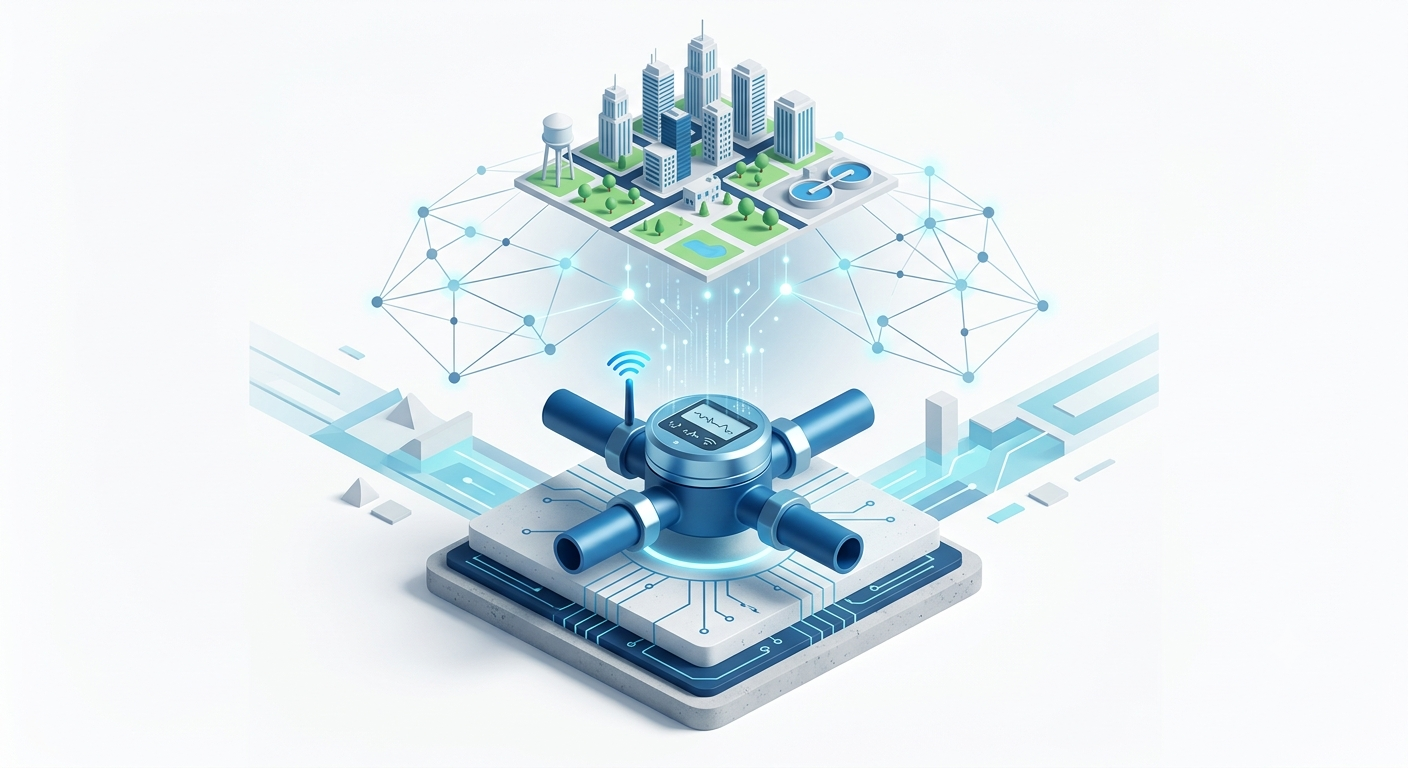
A smart water meter does more than record cumulative consumption. When combined with secure communication networks, a Head-End System, Meter Data Management software, analytics, and utility business applications, it becomes part of an intelligent information infrastructure. This infrastructure can provide utilities with frequent consumption data, operational alarms, device- status information, and visibility into patterns that would remain hidden in a conventional meter- reading environment.
The significance of this change extends far beyond remote meter reading. Automated reading eliminates only one manual process. Smart metering, by contrast, changes how the utility observes and manages its network. Instead of receiving a single consumption value every month or every billing cycle, the utility can access interval data that reveals when water is being used, how consumption changes over time, whether flow continues during normally inactive periods, and whether a customer’s behavior has departed from its historical pattern. This greater level of visibility creates a stronger foundation for operational decision-making. It allows utility teams to investigate unusual consumption earlier, improve billing accuracy, reduce reliance on estimated readings, respond more effectively to customer inquiries, and build a clearer picture of demand across different areas and customer groups. When meter data is combined with district metering, pressure information, geographic information systems, customer databases, and network analytics, it can also support a more comprehensive approach to water-loss management.
The New Reality of Water Utility Management
The need for this intelligence is particularly important in regions where water production and distribution require significant financial and energy resources. Every unit of water lost through leakage, inaccurate measurement, unauthorized consumption, or poor data management represents more than the loss of the water itself. It may also represent wasted energy, treatment cost, pumping capacity, chemical use, infrastructure investment, and potential revenue. For this reason, non-revenue water cannot be treated solely as a maintenance issue. It is a combined operational, financial, technical, and data-quality challenge. Physical leaks are one part of the problem, but apparent losses caused by inaccurate meters, incorrect customer information, data- processing errors, and unrecorded consumption can also affect utility performance. A modern metering strategy must therefore address both the physical accuracy of the measurement device and the integrity of the complete data chain—from the meter and communication network to the software platforms used for validation, billing, analysis, and reporting.
Measurement Accuracy as a Financial and Operational Requirement
Measurement accuracy is central to this process. A meter that fails to register low flows accurately may overlook small but continuous consumption. At an individual property, this can conceal a slow leak. Across a large customer base, the cumulative effect of under-registration can become financially significant. Meter performance must also be considered over the full operational life of the device, not only at the moment of installation. Water quality, sediment, mechanical wear, installation conditions, flow profile, pressure variations, and environmental exposure can all influence long-term performance.
The Role of Ultrasonic Water Metering
This is one reason ultrasonic water metering has gained increasing attention in modern utility applications. Unlike conventional mechanical meters that rely on moving components, ultrasonic meters determine flow through electronic measurement principles. The absence of mechanical measuring elements can reduce wear and support consistent performance, particularly where low- flow sensitivity, long-term stability, or reduced maintenance are important project objectives.
However, meter technology alone does not determine the success of a smart metering program. The selected device must be supported by an appropriate communication architecture, reliable software, effective data governance, suitable installation practices, and clearly defined operational processes.
Communication Technologies for Smart Water Metering
Communication technology is equally critical. Depending on the project environment, utilities may consider NB-IoT, LTE-M, LoRaWAN, Wireless M-Bus, wired M-Bus, or a combination of technologies. The correct selection depends on factors such as meter location, building density, signal penetration, coverage availability, data frequency, battery-life expectations, network ownership, cybersecurity requirements, cost structure, and the need for two-way communication.
A technology that performs well in an open residential development may not be the best option for meters installed in basements, underground chambers, high-rise buildings, industrial sites, or geographically dispersed rural areas. For this reason, smart water metering should not be designed around a single communication technology. It should be approached as an integrated system in which the meter, network, data platform, and operational objectives are evaluated together.
From Connected Devices to Intelligent Utility Operations
The software layer transforms this connected infrastructure into a usable utility resource. A Head- End System manages communication with field devices, collects meter readings and events, monitors device connectivity, and supports remote operations where applicable. A Meter Data Management platform then validates, estimates, corrects, organizes, and stores the incoming information so that it can be used by billing systems, customer portals, operational dashboards, reporting tools, and analytical applications.
Without these processes, a utility may collect large quantities of data without gaining reliable intelligence. Data quantity alone does not improve utility performance. The data must be complete,
accurate, timely, secure, and connected to defined business processes. Utilities must know which events require immediate action, which anomalies should be reviewed, how alarms will be
prioritized, which department is responsible for follow-up, and how the operational value of the system will be measured.
This distinction is important because Advanced Metering Infrastructure should not be treated as a stand-alone technology purchase. It is a long-term digital infrastructure program that affects metering, billing, customer service, information technology, field operations, asset management,
water-loss control, and strategic planning. Its success depends as much on organizational readiness and process design as it does on hardware and software.
A well-designed smart water metering program can create value across the utility. Billing departments benefit from more reliable readings and fewer estimated bills. Customer-service teams gain access to detailed consumption histories that can help resolve disputes and explain unusual charges. Field teams can receive better information before visiting a site. Water- conservation programs can use actual consumption patterns rather than broad assumptions. Asset- management teams can monitor device condition and plan replacement programs more effectively.
Management can use aggregated information to support investment planning, performance monitoring, and demand forecasting.
Customer Engagement and Transparency
Customers can also benefit from greater transparency. Access to timely consumption information can help households and businesses understand how water is being used, identify unexpected changes, and respond earlier to potential leakage. A customer who is informed about continuous overnight flow may be able to repair a hidden plumbing problem before it causes substantial property damage or a severe increase in the water bill. In this way, smart metering can help transform the relationship between the utility and the customer from a periodic billing interaction into a more informed and responsive service model.
Understanding the Scope and Limitations of Smart Water Metering
Nevertheless, smart meters should not be presented as a universal solution to every water-network problem. Meter data can reveal abnormal patterns and support leak investigation, but customer meters alone may not identify the precise location of every distribution-network leak. Effective water-loss management usually requires the integration of multiple sources of information, including bulk meters, district metered areas, pressure sensors, acoustic technologies, hydraulic models, geographic data, field inspections, and customer-level consumption.
The value of smart metering lies in its ability to strengthen this wider operational ecosystem. It provides a detailed and scalable source of consumption information that can improve the utility’s understanding of how water moves from the network to the point of use.
Conclusion
At SenseMi, smart water metering is viewed as more than the automation of meter reading. It is a foundation for accurate measurement, connected infrastructure, secure data collection, improved network visibility, and better utility decision-making. By combining ultrasonic water meters, flexible communication technologies, and integrated AMI software platforms, utilities can move from periodic observation toward continuous operational awareness.
The transition does not happen through technology alone. It requires clear objectives, careful system design, realistic performance indicators, pilot validation, reliable integration, cybersecurity planning, staff training, and a phased deployment strategy aligned with the utility’s operational priorities.
This article examines that transition in detail. It explores the evolution of water metering, the importance of measurement accuracy, the role of ultrasonic technology, the architecture of Advanced Metering Infrastructure, communication-technology selection, data management, leak intelligence, non-revenue water, customer transparency, cybersecurity, sustainability, and the practical steps required to build a resilient and data-driven water utility.