

The Transformation of Middle East Utilities
How Middle East Utilities Are Redefining Energy Infrastructure

Orchestrating the Future:
How Middle East Utilities Are Redefining Energy Infrastructure
The Middle East is fast becoming a global frontrunner in utility transformation. Utility providers in the region are no longer limited to generating and distributing electricity. They are evolving
into intelligent energy partners—orchestrating data-driven, decentralized, and customer-centric ecosystems.

What Has Changed? The Entire Energy Landscape
Ten years ago, the Middle East’s energy landscape looked very different. Now, utilities face pressures from all sides:
• Aggressive national decarbonization targets
• Rapidly expanding renewable capacity
• Rising expectations from customers for efficiency and control
• A surge in EVs, energy storage, and distributed generation
Governments across the region have introduced ambitious decarbonization agendas, accelerating the shift toward cleaner and more sustainable energy models. At the same time, renewable
generation, particularly solar, is expanding at unprecedented speed, reshaping how energy is produced and injected into the grid.
Parallel to this, technologies such as electric vehicles, distributed generation, and energy storage are no longer experimental. What began as pilot projects has moved rapidly into large-scale
deployment, adding new layers of complexity to grid operations. Meanwhile, customers, both residential and industrial, are no longer passive consumers. They increasingly expect
transparency, operational efficiency, and greater control over how energy is produced, consumed, and managed.
In this context, the traditional “generate and sell” utility model is no longer sufficient. Managing modern energy systems now requires the ability to handle multi-directional energy flows,
coordinate a wide range of distributed assets, and optimize performance across entire networks, not just at the level of power plants.
This growing complexity is precisely where energy orchestration becomes essential.

From Infrastructure Operators to Intelligent Energy Partners
Traditionally, utilities operated on a simple model: produce power, deliver it, and bill the customer. Today, the relationship between utility providers and customers is shifting
dramatically.
Gone are the days of passive energy consumers. Today’s customers, whether households, commercial buildings, or industrial sites, are active participants in the energy ecosystem. They
generate electricity through solar panels, store energy in batteries, and shape their own demand through smart systems. And they expect their utility partners to enable and support these
capabilities seamlessly.
This shift creates new opportunities for utilities to deliver value-added services, such as:
• Energy optimization and consultancy
• Integration with smart buildings and IoT systems
• EV charging infrastructure
• Predictive maintenance and asset monitoring
• Transparent, real-time billing and usage analytics
By embracing this expanded role, utilities can move beyond the traditional model of commodity supply. They position themselves instead as trusted energy partners, helping customers achieve
sustainability, savings, and energy independence.
However, the risk is clear: utilities that fail to adapt may be left behind, reduced to mere infrastructure operators while innovation and customer value migrate to more agile players.
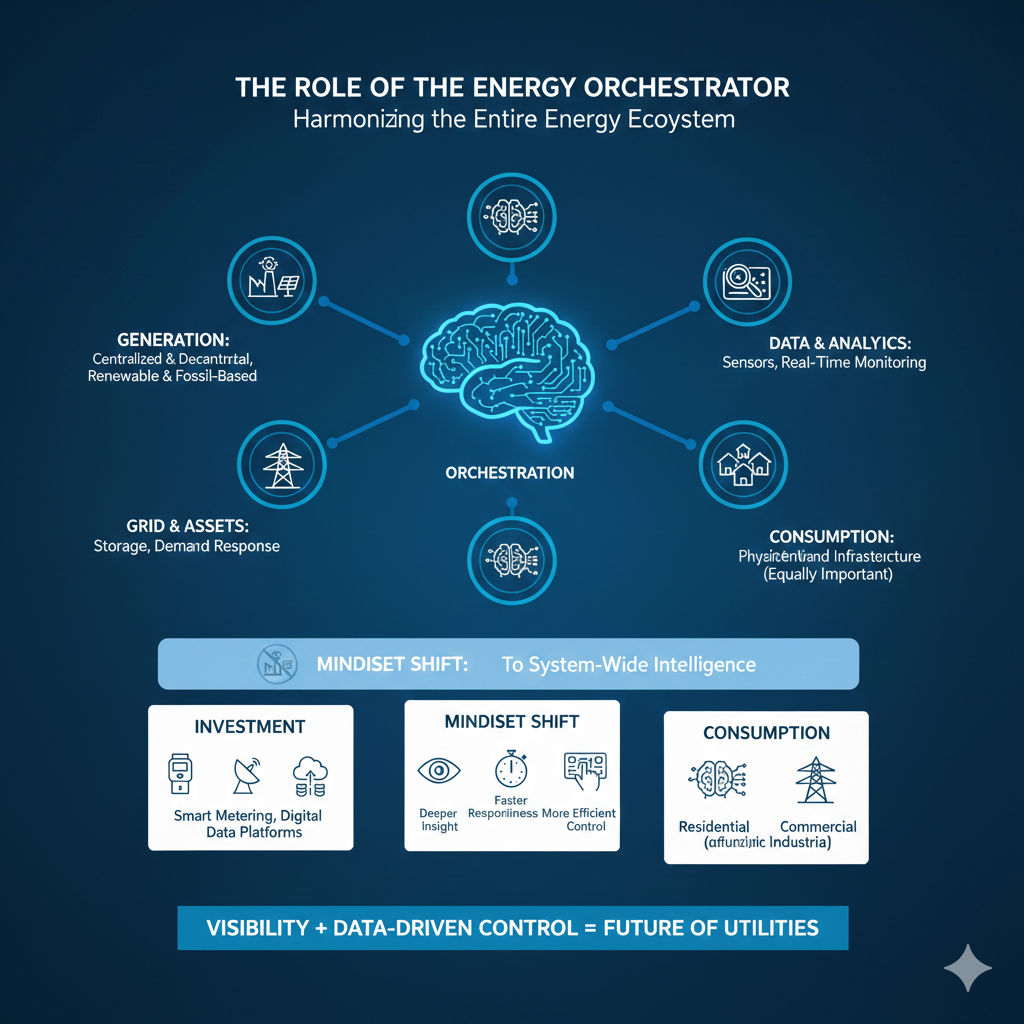
The Role of the Energy Orchestrator
Today’s utilities must do more than generate power, they must harmonize entire energy ecosystems.
An energy orchestrator coordinate:
• Centralized and decentralized generation
• Renewable and fossil-based energy sources
• Grid assets, energy storage, and demand response
• Consumption across residential, commercial, and industrial users
• Analytics, sensors, and real-time monitoring platforms
This transition requires more than just adding digital tools to legacy systems, it demands a complete shift in mindset: from asset-focused operations to system-wide intelligence.
At the heart of orchestration lies visibility. Utilities cannot optimize what they cannot measure, nor can they manage what remains invisible. That’s why the region is seeing significant
investment in smart metering, digital communication technologies, and data platforms, all aimed at delivering deeper insight, faster responsiveness, and more efficient control over energy flows.
As this transformation accelerates, visibility and data-driven control are becoming just as important as physical infrastructure in shaping the future of utilities.

Data: The Most Valuable Resource in Modern Energy Systems
In the world of energy orchestration, data has become just as essential as electricity itself. It fuels insight, drives control, and powers every decision that modern utilities make, from operational
management to long-term strategy.
With the integration of smart meters, intelligent sensors, and advanced digital platforms, utilities today are able to track consumption patterns in real time, right down to the level of individual
users and devices. This enables them to dynamically balance grid loads, thereby improving both system reliability and responsiveness. At the same time, utilities can reduce technical and non-
technical losses, enhancing the overall efficiency of their operations. Data also plays a critical role in forecasting energy demand more accurately, even under volatile or rapidly changing
conditions. Furthermore, it empowers utilities to introduce dynamic pricing structures and implement demand response programs, giving end-users greater flexibility and control over their
energy usage.
These capabilities are especially vital in energy systems that rely heavily on renewable sources such as solar and wind. Since these resources are inherently variable, they require real-time,
high-resolution data and advanced control systems to be integrated at scale without compromising grid stability. Without such tools, renewables can become a source of risk rather
than resilience.
Today’s leading utility providers understand that data is far more than an operational necessity, it is a strategic asset. It serves as the foundation for smarter infrastructure planning, more
meaningful customer engagement, predictive maintenance practices, and the creation of entirely new service models and revenue opportunities. In the digital energy era, those who know how to
harness the full potential of data will gain a decisive advantage in performance, innovation, and long-term sustainability.
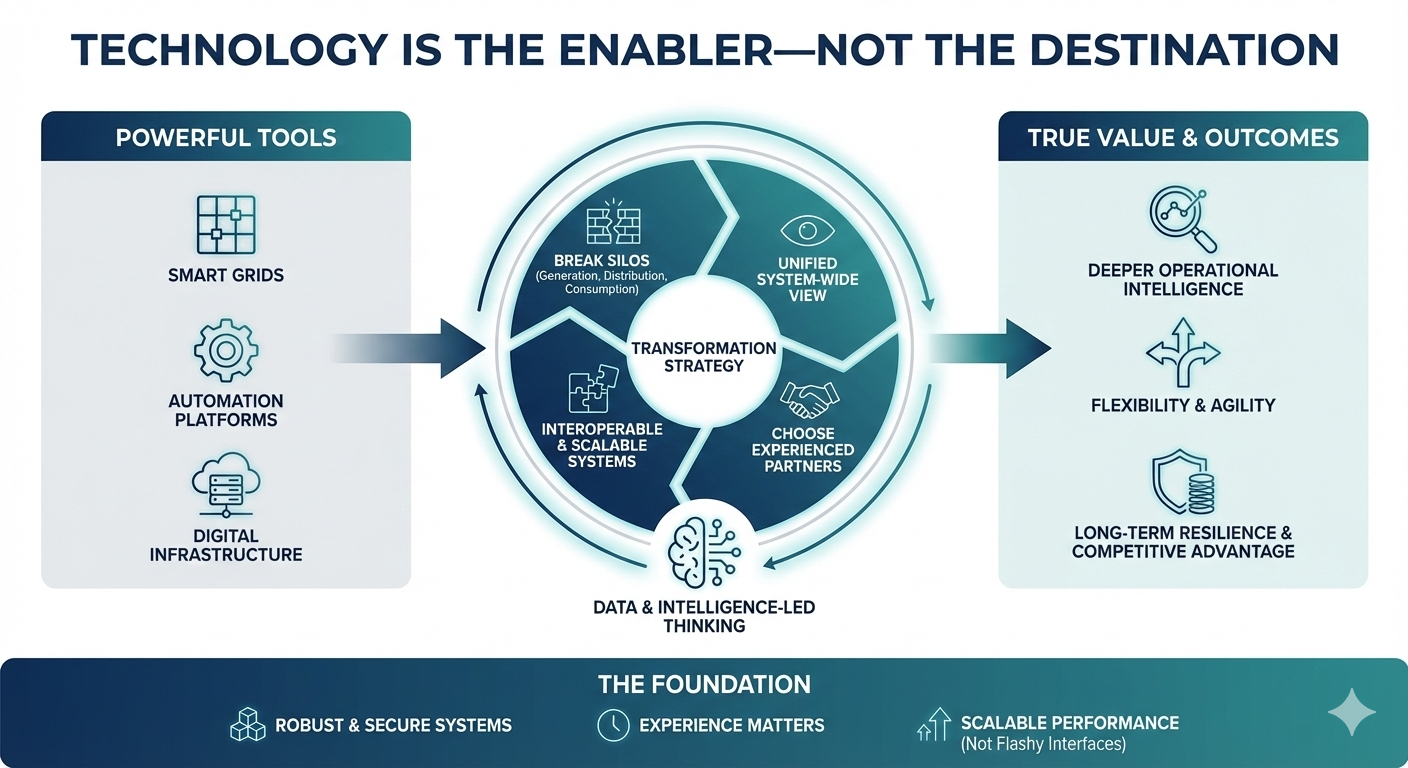
Technology Is the Enabler—Not the Destination
Smart grids, automation platforms, and digital infrastructure are undeniably powerful tools, but their true value lies in how effectively utilities integrate them across the entire energy value
chain.
The real transformation begins when technology is not seen as a standalone solution, but as an enabler for deeper operational intelligence and flexibility.
Achieving this kind of transformation demands a strategic approach. It involves breaking down long-standing operational silos that separate generation, distribution, and consumption processes,
and instead fostering a unified, system-wide view. It also requires the adoption of interoperable systems that can scale seamlessly with increasing complexity and evolving needs. Just as
important is choosing technology partners who understand the real-world challenges faced by utilities, not just software theory or isolated deployments. And critically, it means moving away
from asset-centric thinking toward a model that is led by data, intelligence, and system optimization.
The most forward-thinking utilities are those that do not treat digital tools as quick fixes. Instead, they recognize them as the essential foundation for long-term agility, resilience, and competitive
advantage. In this context, experience matters greatly. Energy orchestration is not about flashy interfaces or temporary trends, it is about building robust, secure, and scalable systems that
perform reliably in the most demanding environments, today and in the future.

Why the Middle East Is Leading the Energy Evolution
Few regions are as well-positioned to redefine the future of energy as the Middle East. The conditions for rapid transformation are not just present—they are uniquely aligned.
The region benefits from:
• Clear, government-driven energy visions and long-term strategies
• Major investments in next-generation infrastructure
• Abundant renewable resources—especially solar energy
• Accelerated urban expansion and rising energy demand
Across the Gulf, utilities are already taking decisive steps: deploying renewables at scale, upgrading grid capabilities, and piloting advanced demand-side response programs. These efforts
are not only about modernization, they are critical to meeting national sustainability targets while delivering consistent performance in environments that pose some of the most extreme
operational challenges globally.
To meet these demands and remain resilient, utility providers in the region must evolve. That means becoming smarter, more agile, and digitally empowered, capable of managing dynamic
energy ecosystems with precision, adaptability, and foresight.

What Comes Next: The Road to Utility Transformation
The Middle East’s shift from traditional power production to intelligent energy orchestration is already in motion. The question is no longer if this transformation will happen—but how fast and
how effectively each utility will adapt.
Those that take bold action today will:
• Boost operational performance through data-driven intelligence
• Play a leading role in national decarbonization and sustainability agendas
• Increase grid resilience amid growing complexity
• Deliver higher value to customers through digital engagement
• Secure their position in the future energy landscape
On the other hand, utilities that hesitate risk falling behind, forced to retrofit intelligence into outdated systems never designed for flexibility or coordination.
The Utility Model Has Changed Forever
For many years, the role of a utility provider was clear-cut: generate electricity, deliver it to consumers, send the bill, and start over. This linear approach worked well in a time when energy
networks were centralized, demand patterns were stable, and system complexity was minimal. But that era has passed.
Today, across the Middle East, utility companies are embracing a fundamental transformation. No longer confined to simply producing and distributing energy, they are evolving into energy
coordinators, entities that must oversee dynamic, decentralized networks where generation, consumption, storage, and environmental responsibility must be balanced intelligently and in real
time.
This transition isn’t optional. It’s being accelerated by a powerful combination of regulatory shifts, economic drivers, technological advancement, and changing customer expectations, all
moving faster than legacy utility systems were ever built to handle.

Orchestrating the Future of Energy
The future of energy is dynamic, decentralized, and deeply digital. Managing such systems demands a mindset shift, from command-and-control to coordination, from scale-centric to
intelligence-led.
Utilities are no longer just providers of power. They are becoming the conductors of complex energy ecosystems, balancing supply and demand, integrating renewable sources, and ensuring
that every device, asset, and data stream works in harmony.
And across the Middle East, this future is arriving faster than ever.
Let SenseMi help you orchestrate smarter energy infrastructure.